Japanese Kobe Beef Japanese Kobe Beef Price
Cows that drink beer, are massaged with rice wine and mind to classical music?
For meat lovers, Kobe beef is considered the image of fine dining.
But what is Kobe beefiness, where does Kobe beef come from and why is information technology so expensive?
Photograph used with permission courtesy of @somewhere.in.jp
So, what is Kobe beef exactly?
Kobe beef, sometimes misspelled as Colby beef, comes from the Tajima-gyu breed of cattle establish in Japan's Hyōgo Prefecture, of which Kobe is the capital and the meat's namesake.
Introduced equally work animals in the rice cultivation industry during the second Century, Tajima-gyu became isolated from other breeds in the small pockets of arable land within Nippon'south mountainous landscape.
Herd isolation and distinctive feeding techniques are said to accept led to unique differences in taste and texture.
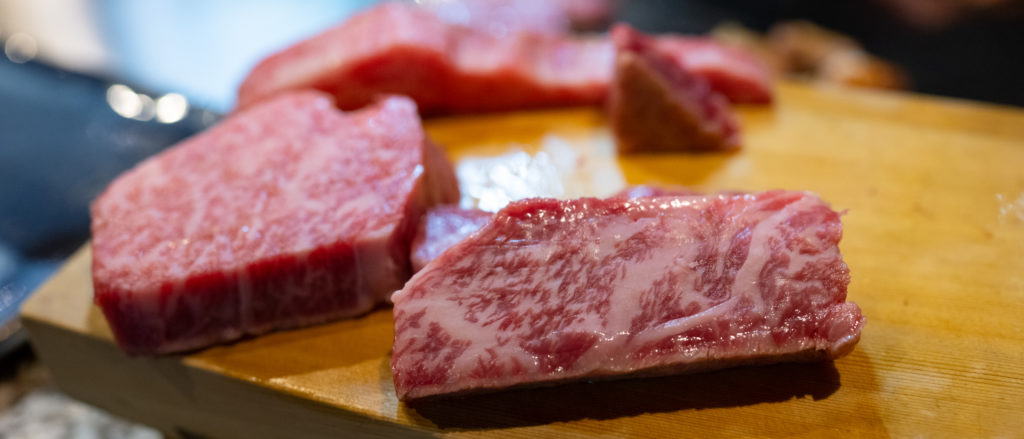
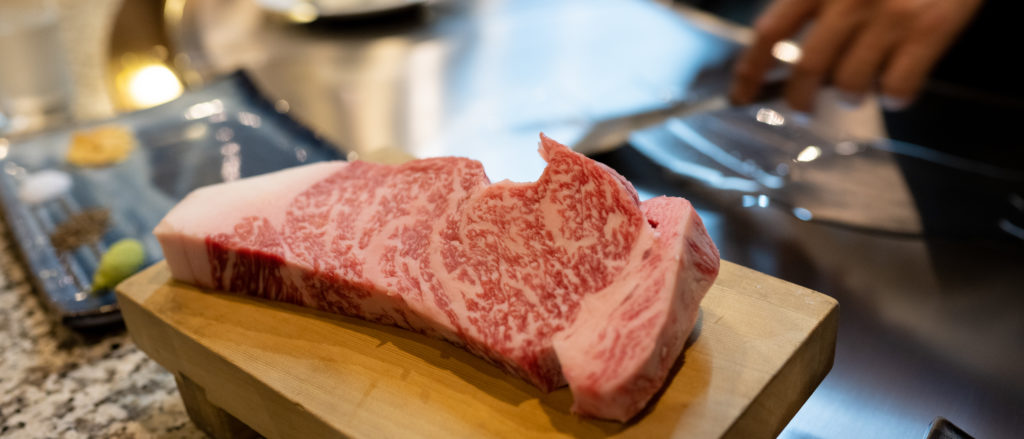
Kobe beef is renowned for its superior flavor, tenderness and high amount of intramuscular fat, giving the meat a marbled appearance. Information technology is often cited as being healthier than commercial beef because of its high concentration of monounsaturated fats and omega-3s.
Its prized value must besides exist credited to the mysterious rearing techniques said to assist the meat'due south delectable season and texture.
There are three major stories that crop up time and time again and have achieved somewhat of urban legend status.
- The first is that the cows are given beer to induce appetite.
- The 2nd is that they are massaged daily, sometimes with sake (Japanese rice wine), equally a proxy for exercise in the tight living quarters and to further accentuate the marbling that Kobe beef is so well known for.
- And the third is that classical music is played to them every bit a relaxation technique and at feeding time, so they associate the music with eating and hence the music improves their appetite.
While there is no hard bear witness to suggest that whatever of these techniques improve season or texture, they certainly requite the imagery of the cows living as kings, adding to the decadence of a Kobe beef meal.
Wagyu vs Kobe
Then, what is wagyu beefiness and what is the divergence betwixt wagyu and Kobe beef?
Wagyu merely ways Japanese cow or cattle. It is a holistic term that is used to refer to any meat from Japanese cattle and, despite common misconception, wagyu is not a brood itself, nor does the term accept whatever relation to quality. So when we talk about 'wagyu meat' or 'wagyu steak,' it but ways information technology came from a Japanese moo-cow.
Wagyu cattle are classified into four breeds – Japanese Black, Japanese Brownish, Japanese Poll, and Japanese Shorthorn.
Tajima-gyu cows, from which Kobe beef comes from, belong specifically to the Japanese Blackness breed.
Only meat of Tajima-gyu cows that fulfill strict lineage and quality criteria can be termed 'Kobe beefiness.'
This means that all Kobe beef is wagyu beef, just only a very modest proportion of wagyu beef is Kobe beefiness.
In fact, only around 3,000 heads of Tajima-gyu cattle are certified equally Kobe beef each year. Kobe beef contributes to just 0.06% of beef consumption in Nihon, and only a very small fraction of that is exported.
You can already begin to sympathize how rare real Kobe beef really is.
Photograph used with permission courtesy of @somewhere.in.jp
Wagyu beef grades and Kobe beef grades
Equally Kobe beefiness is a type of wagyu beef, Kobe beef is graded using the wagyu grade system. This organization uses a combination of letters and numbers and is used to rate the quality of Japanese beef.
Wagyu is given a letter form (A through C) for yield and a number grade (i through 5) for quality.
Yield grade
Yield grade determines the 'cutability' of the meat, meaning the proportion of meat that can be obtained from a certain role of the moo-cow's carcass.
Grade A : To a higher place standard
Grade B : Standard
Grade C : Below standard
Quality grade
Wagyu beef quality is adamant by evaluating four different categories: the thin strips or flecks of fat known as marbling; the color and brightness of the beefiness; firmness and texture; and the color, luster and quality of the fat.
The beef is assigned a number class from one-5 for each of the categories.
5: Excellent
4: Adept
3: Average
2: Below average
ane: Poor
Within the marbling category, there is additional grading based on the Beef Marble Score (BMS). The BMS allows the distinct marbling of the beef to be graded to an even finer degree of accuracy, and is given a number grade of 1-12.
This shows only how important marbling, known as 'sashi' in Japanese, is to the quality of wagyu and the overall melt-in-your oral cavity experience of loftier quality Japanese beef.
Course BMS No.
v: Excellent 8 – 12
4: Good v – seven
3: Boilerplate 3 – iv
2: Below average 2
1: Poor 1
The best score that can be obtained is A5, and within that A5-12, the latter existence extremely rare.
According to writer of 'Real Food, Fake Nutrient' and nutrient journalist Larry Olmstead, "USDA Prime, our highest marbling grade, equates to nearly iv (on the BMS scale). Well-nigh domestic Wagyu or hybrids would score six-9, while Kobe normally ranks ten or higher."
Quality scores are taken extremely seriously and are washed by no less than iii independent highly-trained assessors, whose scores are combined to found a final score.
Japanese beef must grade at the same level across all quality criteria to be given that status. For instance, beef that is assessed equally A for yield and five across three of the four quality measurements, and 4 for one, tin can only be given a score of A4.
For wagyu beef to exist classified as Kobe beef, information technology must have a yield and quality score of A4 or A5. Just that's non all.
Photo used with permission courtesy of @somewhere.in.jp
What are the requirements for existent Kobe beef?
To exist classified equally accurate Kobe beef, in that location are various boxes that must be checked.
Kobe beef cows
Recollect that Kobe beefiness must come from a Tajima-gyu cow, belonging to the Japanese Black breed. Not only that, but it must exist of pure-breed Tajima-gyu lineage, be a steer (castrated bull) or virgin cow, and have been born and raised in Hyōgo Prefecture, Japan.
During its life, it must take been fed simply grains and grasses from within the Prefecture, and upon its decease, be processed in approved slaughterhouses in Hyōgo, and have a gross carcass weight of 470kg or less.
Kobe beef quality
Think the yield and quality scores for wagyu we talked about higher up? Kobe beefiness must accomplish the highest grades of A4 or A5. In add-on, the Beef Marbling Score (BMS), must be six or above.
Grade BMS No.
five: Excellent 8 – 12
iv: Proficient 5 – 7
This ways that A4 wagyu with a BMS of 5 does non meet the criteria to be chosen Kobe beef.
Kobe beef actuality
Kobe beef must be assigned a 10-digit ID number, so that its actuality tin can be traced back to the private cow it came from.
Simply when all of these requirements are satisfied, can a piece of wagyu be chosen Kobe beef or Kobe steak. If you've e'er asked yourself, why is Kobe beef so expensive? Then this is information technology.
Photo used with permission courtesy of @somewhere.in.jp
Kobe beefiness price and wagyu beef toll
Kobe beef is rare and expensive, even in Japan.
Kobe beef price per pound in Nihon (well-nigh 450 grams) is virtually $300, simply y'all can pay around $500 for the best cuts of meat at finer establishments.
Given its scarcity and cost tag, nearly Japanese have never tasted it, and those who have generally reserve information technology for a very special occasion.
In the U.s., you can look to pay $50 per ounce (less than 30 grams). While wagyu can exist half that.
Buyer beware – the large Kobe beefiness and wagyu scam
With its reputation for excellence and consumers ready to open up their wallets for a taste of it, information technology's unsurprising that restaurants the globe over have tried to cash in on the Kobe beef name.
While there are strict laws in place on the usage of the term 'Kobe beef' in Japan, such standards are largely unrecognized abroad, meaning that restaurateurs exterior Nihon are not bound by the same stringent guidelines, leaving them to get artistic with their card descriptions.
You've no dubiousness encountered menu items such as American Kobe beefiness, Kobe burgers and Kobe beef sliders.
The reality is well-nigh all beef marketed every bit Kobe beef outside of Japan is not really real Kobe beef.
American Kobe beef
American Kobe beef is an oxymoron.
Kobe beefiness must come from Tajima-gyu cattle that were built-in, raised and slaughtered in Hyogo Prefecture and take only been fed from grains and grasses from within the Prefecture, and hence any beefiness produced in the The states, whether from Tajima-gyu cattle or not, cannot be Kobe. Plain and simple.
The usage of terms such as 'American fashion Kobe beef' or 'American Kobe style beefiness' seems to exist a clever semantic variance being employed by a number of restaurants who want to leverage Kobe beef'due south reputation, while trying to mitigate any potential consumer-related backlash.
That said, at that place take already been several course activity suits filed against restaurants in America who were allegedly selling fraudulent Kobe beefiness, and affected consumers are demanding their money dorsum.
According to Attorney Kevin Shenkman, who served as class counsel for suits against a number of these restaurants and dining groups, explains:
"These businesses are passing off their beefiness as being Kobe beefiness when it is anything merely Kobe beef and they're charging premium prices to consumers who are paying those prices because they retrieve that it is in fact Kobe beef and it's not."
Nonetheless despite growing media attention, it seems to have made fiddling difference to consumer sensation or spending in the U.s., where carte du jour items like Kobe sliders take already taken a foothold in the new age of foodie-ism.
The term Kobe, and even wagyu, is used so liberally on menus in America that customers accept almost come up to expect these 'premium' options from just about any neighborhood chophouse, without considering glaring facts.
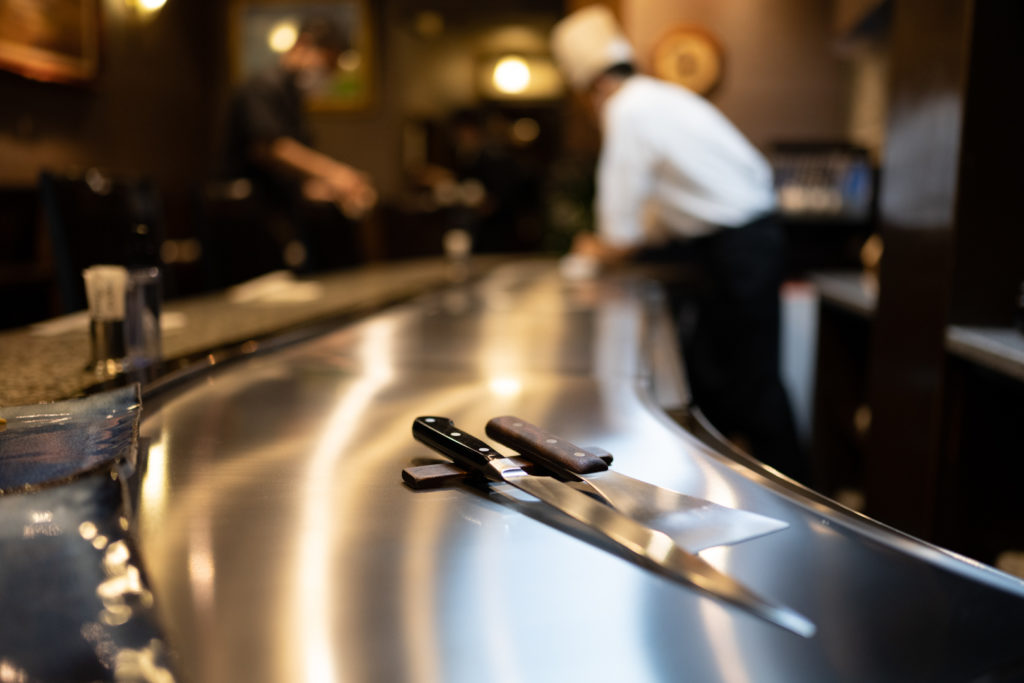
Photo used with permission courtesy of @somewhere.in.jp
Wagyu beef and Kobe beef in the U.s.
From 2010 to Baronial 2012, the import of whatever Japanese wagyu beef from Japan, Kobe or otherwise, to the U.s. was banned due to concerns over human foot and rima oris affliction believed to have originated from livestock in Japan.
Even prior to that, only boneless, fresh Japanese beefiness could exist imported and none of it was Kobe, as slaughterhouses in Hyōgo Prefecture (from which only authentic Kobe beefiness can come from) were not approved for consign past the USDA.
Therefore any restaurant claiming to be serving Kobe beef in whatsoever grade in the Us before August 2012 was being a bit artistic with their menus.
While the USDA's ban on Japanese beef importation was lifted on 27 August 2012, only very small quantities of Kobe beefiness are distributed to select buyers. Most Kobe beef remains in Nihon for domestic consumption.
Fifty-fifty the term 'wagyu' is very loosely applied in the United States. While pure-bred Japanese cattle practise be in the United states, meat demand only be 46.9% Japanese to be labelled wagyu.
Oft wagyu in the United States is cross-bred with Angus cattle and may be more Angus beef than wagyu. However, even this very broad definition of wagyu but applies to farmers and abattoirs; it does not extend to restaurants.
So substantially restaurants can sell whatsoever beef equally wagyu or Kobe beef, and many do.
Where to go existent Kobe beef
Fortunately, there is a lot you can do to protect yourself as a consumer and to avoid being duped into paying for something that is not the real deal.
Cheque the toll tag and skip the Kobe beef burgers
As announcer Larry Olmstead who has done significant research into Kobe beef fraud says, "High prices don't guarantee that you are getting Kobe beef but low prices well-nigh guarantee that you're not."
Toll is a proficient first indicator. As much as nosotros'd all like to remember we tin get a premium Kobe steak or burger for an extra $10 at the local gastro pub, unless you're paying a couple of hundred bucks for it, it's not Kobe beef.
And no i in their correct heed is going to grind upwardly top-quality wagyu, much less prized Kobe beefiness, into a hamburger patty in the offset place. There is essentially no such affair as ground Kobe beef.
The tardily great Anthony Bourdain described Kobe sliders as the worst dish in America. "What makes Kobe good is texture. You lose all of that immediately (in a Kobe slider).
"There's no way that yous could capeesh the things that brand Kobe interesting and good and expensive in a little burger or a meatball drowned in sauce. I mean information technology'south light-headed."
Only even when the dish appears to exist prepared in a logical mode and the cost seems right, this doesn't guarantee that you're beingness served what yous ordered. For that we demand to dig a little deeper.
Ask your server
Whatever restaurant serving real Kobe beef should be able to tell y'all exactly where it came from, its precise grade, their distributor, and exist able to produce the x-digit authentication number.
Kobe beef is not like shooting fish in a barrel to procure. If they don't know or hesitate, this is a sure sign that it is not authentic Kobe beefiness.
Check if the eating house, retailer or wholesaler has actually imported Kobe beefiness with this easy online search trick
Kobe beef is highly coveted and regulated in Japan; they don't simply send it anywhere without knowing exactly who information technology is going to and where it volition finish up. Fortunately for consumers, this information is bachelor freely online.
In the Us, in that location are currently just 40 restaurants that have access to genuine Kobe beefiness.
You can find a listing of overseas accredited restaurants and distributors here.
You can also search by the x-digit hallmark number to cheque that it is a legitimate number.
In addition, yous can check when the beef was exported and the company information technology was imported past hither.
If the data you are given by an establishment cannot exist confirmed here, something is awry.
The most expensive beefiness in the world
Given its price and reputation, you might think that Kobe beef is the most expensive beef in the globe. But, in fact, it's not even the most expensive or well-nigh prized wagyu.
That honour goes to Matsusaka beef, which domestically in Japan is generally considered to be the best Japanese beef due to its college on average fat content, a central indicator of quality wagyu. While Kobe beef must have a BMS of half dozen+, Matsusaka must be 10-12.
The most expensive beef in the world though is reportedly from a farm in Northeastern France where a butcher who runs his ain butchery creates aged steaks from his Blonde Aquitaine stock through a process of hibernation. Through the procedure, in which cold air is blown at 75 km per 60 minutes onto the meat in a -45 degree Fahrenheit environment, the beef may be kept for an indeterminate corporeality of time without loss of quality.
A 2000 vintage cote de boeuf (rib steak) costs around $3,200.
Conclusion
All this data may sound confusing, simply at the finish of the twenty-four hours, information technology's quite simple. Do your research and avoid inexpensive (and expensive) imitations.
Go straight to the source and select an accredited Kobe beef restaurant, retailer or wholesaler in your state from the list or salvage your pennies for a trip to Japan for the guaranteed real bargain.
And the beer, massages and music, I hear you ask? While I hate to put a dampener on a good story, it basically has to be put down to myth.
Information technology's certainly plausible that some farmers take used such techniques (and perchance that is where such legends derived), but it's definitely non an manufacture-wide standard.
In the words of Yoshinori Nakanishi, a Kobe cattle farmer who'due south been in the business organisation for nearly 40 years, "Neither I nor any beef farmer I know would always dream of giving cows beer."
Judge they'll just accept to let the gustatory modality speak for itself. Luckily for them, one bite of the famed "cook-in-your-mouth" fare normally requires little convincing.
Have you tried Kobe beef? Would you like to? Let united states know in the comments!
Interested in an outdoor Japanese BBQ experience where all you have to do is show up? Meat prepared and gear up to cook, cleaning of the grill done for you lot, a nice spot prepared to sit and savor time with family and friends? Read about Nihon's 'Tebura BBQ' service!
Source: https://notesofnomads.com/kobe-beef/
0 Response to "Japanese Kobe Beef Japanese Kobe Beef Price"
ارسال یک نظر